
Questions People Ask Before Their First Story Circle
The questions we hear most often about Story Circles, from what you must share to how stories are retold with consent, answered plainly by the editor who has sat in many of them.
Margaret Hollis · · 6 min read
The question behind most questions
When someone writes to us about Story Circles, the message usually starts with a practical detail, such as the start time or whether to bring anything, and ends with the real worry: will I be asked to say more than I want to? I have answered that message many times, so I decided to set the answers down in one place for these autumn weeks, when people tend to come indoors and think about gatherings.
A Story Circle is a small group that meets to share personal stories and to talk about how those stories might be retold with care and consent. That second half matters as much as the first. We are not a therapy group and not a writing class with grades. We are neighbours around a table, listening carefully and thinking together about what a story needs.
Priya Nair, who hosts the circles, opens each evening by saying what the room is for and what it is not for. I will repeat the substance of that here, because newcomers often tell us it was the sentence that let them relax into the chair.
Do I have to speak?
No. Listening is a full way of taking part, and plenty of people spend their first evening or two doing only that. Nobody goes around the circle demanding a turn. Priya invites, and the invitation can be declined without any explanation, with no awkward pause and no second request.
Those who do speak are asked to choose their own scale. A story can be two minutes about a corner shop that no longer exists, or a longer account of a family move. We do not rank them. Small, ordinary stories often open the best discussion, because everyone in the room has a version of them.
If you arrive intending to speak and change your mind halfway through a sentence, that is allowed too. You can stop, pass, or say that you would rather keep the rest for yourself. The group simply thanks you for what you offered and moves on.
- Listening counts as taking part
- You choose how long and how personal a story is
- Stopping mid-story is always allowed
What happens to a story once it is told?
This is the question I care most about, and the answer is short: nothing happens to it without your say. What is said in the circle stays in the circle unless the person who told it agrees to something else. We do not record, transcribe or photograph the evenings, and members are asked not to repeat each other's stories elsewhere.
If a member later wants to turn a story into a written piece or a photo essay, that is a separate conversation, held with the person whose story it is and with anyone else who appears in it. We talk about what to include, what to leave out, and whether names or faces should be changed or withheld.
Consent is not a form signed once. It can be given for one version of a story and withdrawn for another, and it can change a month later. We treat a change of mind as a normal part of the work, never as an inconvenience.
- Nothing is recorded during the evenings
- Retelling needs the teller's agreement, version by version
- Consent can be withdrawn at any stage
What if my story involves other people?
Almost every personal story does. A parent, a former employer, a neighbour from forty years ago all walk through the telling. We ask members to think about how those people would feel hearing themselves described, and whether the story needs their name to work.
Practical habits help. You can describe someone by role rather than name, shift a detail that would make them easy to identify, or leave a painful moment out of anything that travels beyond the room. None of this weakens a story. It often sharpens it, because the teller has to decide what the story is really about.
When a story touches on something that could hurt a living person, Priya will say so gently and suggest waiting, or asking that person first. The aim is to keep the circle a place where honest storytelling and respect for others sit side by side.
Who comes, and how does an evening feel?
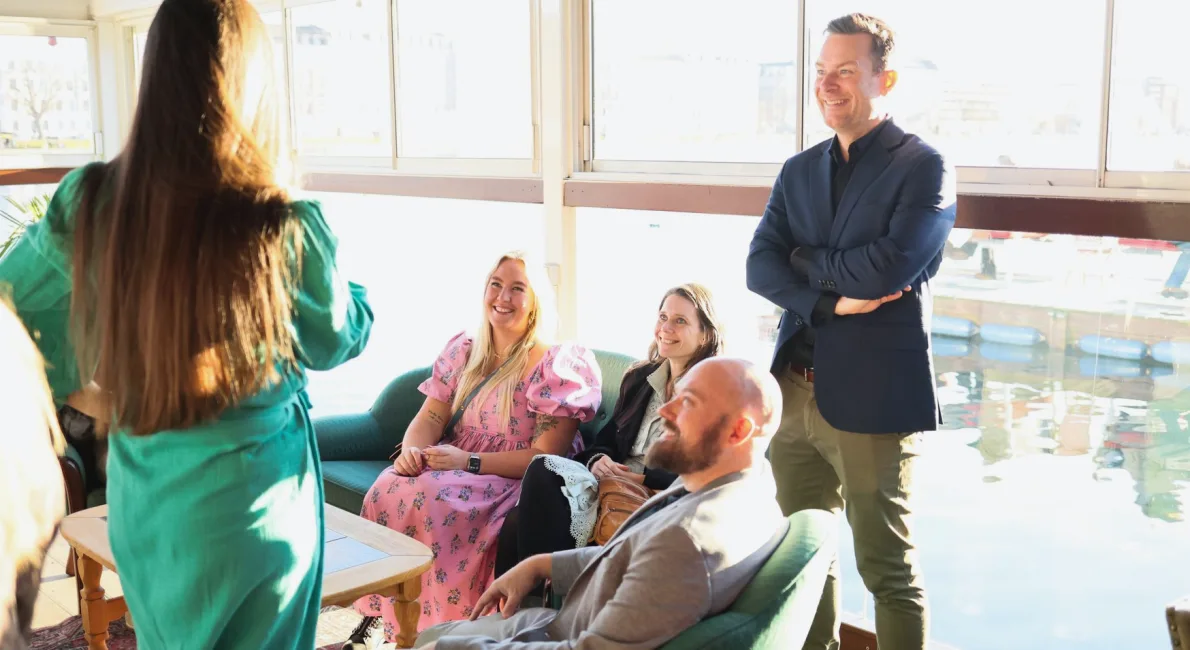
The people who come are mostly adults, many of them over forty, and the mix changes from one evening to the next. Some arrive from the photo walks or the print review nights and want to understand the people behind their pictures. Others have never held a camera and simply like to tell and hear stories.
An evening begins with a short welcome and a reminder of the ground rules, then moves into stories, with pauses for tea and quiet. Priya keeps time without hurrying anyone. Afterwards the talk turns to craft: where a story starts, which detail carries the weight, and what a listener needed to hear.
You do not need experience, a notebook or a finished story. A memory that has been sitting at the back of your mind is enough to begin with.
- No experience or preparation required
- A short welcome, shared stories, then a conversation about retelling
- Tea and quiet pauses are part of the evening
How to decide if it is for you
If you are still unsure, ask yourself two plain things. Would you like to hear other people's stories told without interruption? And would you like help thinking about how a story of your own could be shared with care? A yes to either is a good reason to come once and see.
Coming once commits you to nothing. You can sit near the door, listen, and leave when the evening ends. Several members tell us they came three times before saying a word, and that those evenings were not wasted.
If you have a specific worry that this article has not covered, write to us through the contact page. Priya or I will answer honestly, including when the honest answer is that the circle may not suit what you are hoping for.
Most hesitation about Story Circles comes down to control: who hears what, who decides, and whether you can leave a sentence unfinished. The answers are that you decide, the room listens, and a story is only ever retold with the teller's agreement. If that sounds like a room you would be comfortable in, come along this autumn and see how it feels.